What is SAP BTP ?
It is a platform as a service ( Paas ) offering from SAP which offers different kind of services like application development, data warehouse & management, analytics and intelligent technologies ( shown in the diagram below ). In Platform as a Service, the applications and data are managed by the user whereas everything else that lies underneath is managed by the service provider.
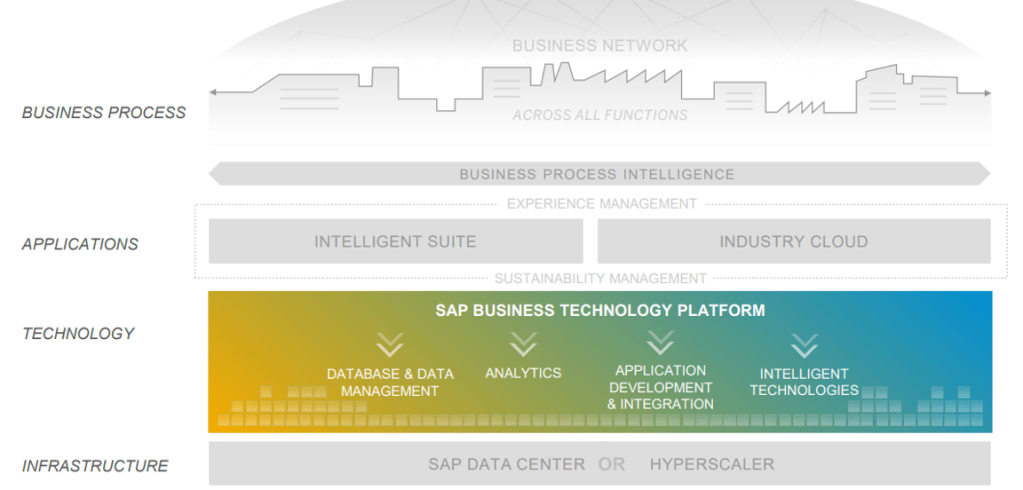
Source : sap.com
Why one should use BTP ?
Below are the reasons
- You just have to focus on building application and business logic rather than managing the software
- you get out of the box integration with applications on S4HANA
- You don’t have to bother about underlying hardware, network, security etc.
Now the question that comes to our mind is why BTP if we are going to use using AWS, Azure etc.
So the thing is you can develop your applications on AWS without BTP but in that case you have to take lot of aspects into consideration like security, OS management, integration and this is where BTP makes our life easy. BTP offers pre-built integration libraries and APIs that enable the customers to easily integrate their SAP systems with other SAP systems, as well as with third-party applications. BTP offers pre-built integration libraries and APIs that enable the customers to easily integrate their SAP systems with other SAP systems, as well as with third-party applications.
Open sap course – https://open.sap.com/courses/btp1
Cloud Foundry
Cloud Foundry is an open-source platform that is governed by Cloud Foundry Foundation not owned by SAP but sap is a major contributor to Cloud Foundry for the past few years and it is hosted on the BTP. It is also available on other cloud platforms like AWZ, Azure, GCP etc.
Why cloud foundry ?
It is mainly used to build, deploy and run applications that are built using different programming languages.
Lets say you are building an application in that case you have to install runtime of the programming language that you are using, you will need a code editor , a database where you can commit your changes, code editors , authentication services etc. Now imagine doing all this for a application that you are developing in cloud. This is where cloud foundry comes into picture.
Cloud Foundry offers runtimes, business services, programming languages, libraries and services all in one place. So, the developers can concentrate on coding while the admin tasks are taken care of by the Cloud Foundry and it supports different kind of programming languages including ABAP.

Main features of cloud Foundry
- BOSH can provision and deploy software over hundreds of VMs. It also performs monitoring, failure recovery, and software updates with zero-to-minimal downtime.
- SAP puts Cloud Foundry on top of existing IaaS environments and uses the provided APIs as backbone of Cloud Foundry
- •Management of an SAP Cloud Foundry Account can be done via the CloudFoundry Command Line Interface (CF CLI) or the SAP BTP Cockpit
- •Developers can bring their own language (e.g. Python, Node.js,Java) using existing or custom buildpacks
So Cloud Foundry lets developers focus on the application code and care less about the actual underlying infrastructure.
So the main focus of SAP BTP is that developers should focus on building the applications i.e. they should focus on achieving the business requirement and other things would be managed by BTP. One of the reasons customer opt for BTP is because they offer pre-built integration with different services of SAP and you don’t have to bother about writing code to
The other point to note here is that BTP is usually hosted on a hyperscaler i.e. AWS, azure or GCP .
Application Development CAP
What is cloud application programming model ?
- •Framework of languages, libraries and tools that allow rapid application development on BTP
- •Mix of open-source based and SAP specific technologies

•CAP mainly adds Core Data Services (CDS) as universal modeling language for both
domain models and service definitions
Best choice for building transactional business application on BTP with focus on CRUD services
 Binarybuggs